GRATIOT CONSERVATION DISTRICT
  • Home
  • About
    • Services >
      • Wildlife Habitat Seeds
      • Equipment Rental
    • Annual Reports >
      • GCD History
    • Donate >
      • List of Sponsors
    • Our Team >
      • Join Our Team
      • The GCD Board
      • Partners >
        • NRCS
  • Events
    • Education & Workshops >
      • Forest Hill Nature Area
      • Water Quality
      • Septic Programs
  • Wildlife Habitat
    • Wildlife >
      • Hunting & Access
      • U.S. Fish and Wildflife
    • Habitat >
      • Invasive Species
      • Native Landscaping
      • Habitat Restoration Projects
  • Farming
    • What is Regen Ag?
    • MAEAP >
      • Farm A Syst
      • Forest, Wetlands & Habitat A Syst
    • NSP Pollution
  • Watersheds
    • Bad River Watershed
    • Maple River Watershed
    • Pine River Watershed
  • Contact
    • Accessibility

12/18/2018

Where Does Your Water Come From?

Read Now
 

What Is Water?

​Water is an odorless, tasteless, colorless liquid made up of hydrogen and oxygen. Water is a necessary component of human survival and is a vital part of Michigan’s economy. In fact, Michigan is home to approximately 20% of the Earth’s usable fresh water. There are two types of water, groundwater and surface water.

​➻ GROUNDWATER is water that is underground in cracks and spaces in the soil, sand and rocks.
➻ SURFACEWATER is water that is above the surface of the land (i.e. lakes, rivers, streams).

Water, Water, A Continuous Cycle

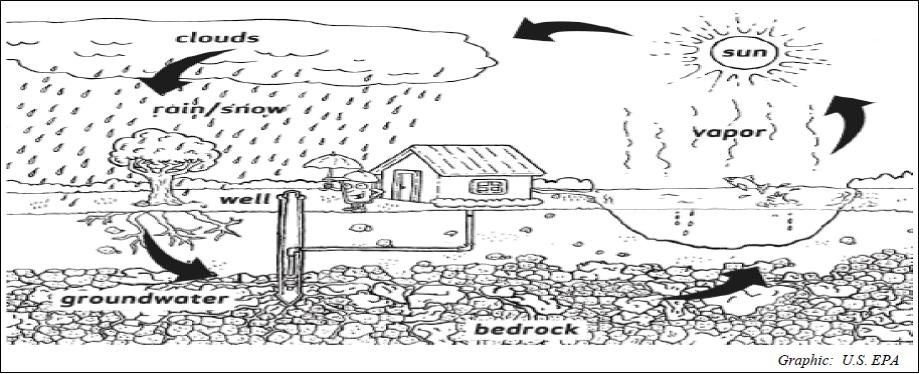
Water moves through a continuous cycle known as theWater Cycle. TheWater Cycle is the paths that water takes through its various states as it moves throughout the atmosphere. First, a vapor becomes a liquid through condensation. Second, the liquid (rain, snow, sleet) falls to the ground through precipitation. Third, the water either seeps into the ground, forming groundwater or it runs off the surface of the land, forming surface water. Finally, the liquid converts back into a vapor and evaporates up into the atmosphere through evaporation.
Picture

What Is Groundwater?

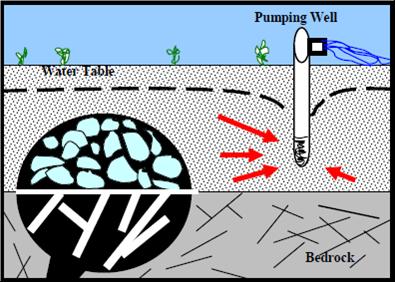
Groundwater fills the small spaces between rock particles (sand, gravel,
etc.) or cracks in solid rock. Rain, melting snow, or surface water becomes groundwater by seeping into the ground and filling these spaces. An aquifer is any type of geologic material, such as sand or sandstone, which can supply water to wells or springs. Groundwater, which supplies wells, often comes from within a short distance (a few miles) of the well. How fast the groundwater moves depends on how much the well is pumped and what type of rock particles or bedrock it is moving through.
Picture

Share

Henry Killingsworth link
7/18/2022 12:48:18 pm

I thought it was informative when you mentioned that groundwater is what supplies wells. I would imagine that a well would have to reach a certain depth in the ground to have enough access to water. If you are wanting a water well, it seems like you are going to make sure that you have it drilled deep enough.

rural and regional bore water link
7/27/2022 04:30:30 am

What precisely is done to ensure that tap water is safe to drink for the typical American? As previously said, surface water (think lakes and rivers) and groundwater are the two main natural resources from which we obtain our drinking water. Typically, water travels from water intake sites to a water treatment plant before entering our houses via public water systems. Due to potential impurities in the water, treatment methods work to get rid of pathogens and make the water safe to drink while adhering to local, state, and federal standards.


Comments are closed.

Contact GCD

  • Home
  • About
    • Services >
      • Wildlife Habitat Seeds
      • Equipment Rental
    • Annual Reports >
      • GCD History
    • Donate >
      • List of Sponsors
    • Our Team >
      • Join Our Team
      • The GCD Board
      • Partners >
        • NRCS
  • Events
    • Education & Workshops >
      • Forest Hill Nature Area
      • Water Quality
      • Septic Programs
  • Wildlife Habitat
    • Wildlife >
      • Hunting & Access
      • U.S. Fish and Wildflife
    • Habitat >
      • Invasive Species
      • Native Landscaping
      • Habitat Restoration Projects
  • Farming
    • What is Regen Ag?
    • MAEAP >
      • Farm A Syst
      • Forest, Wetlands & Habitat A Syst
    • NSP Pollution
  • Watersheds
    • Bad River Watershed
    • Maple River Watershed
    • Pine River Watershed
  • Contact
    • Accessibility